Every few months, a new headline appears:
“This is the end of audiobook narrators.”
“AI voices will replace human narration.”
“Why pay a narrator when technology can do it faster?”
The conversation usually sounds dramatic, urgent, and final.
But reality is more nuanced — and far more interesting.
Audiobook narration is not ending.
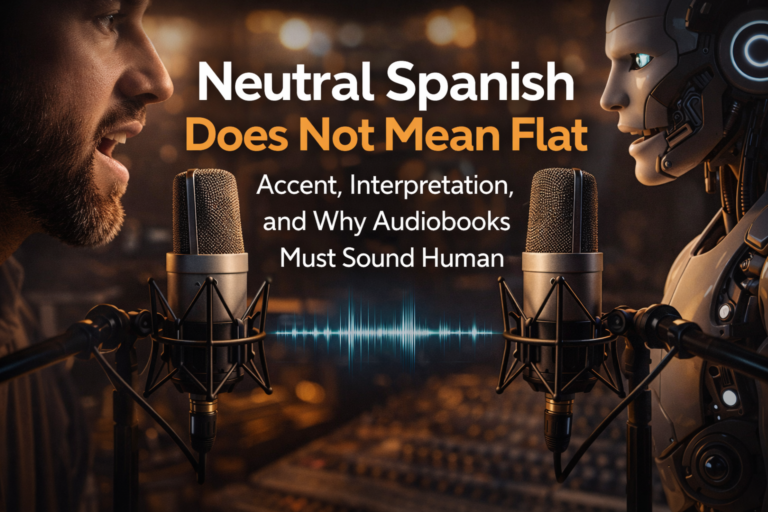
What is ending is the era of confusing voice generation with interpretation.
What AI Voices Actually Do Well (and Why They Exist)
Let’s start by being honest.
Tools like ElevenLabs are impressive.
They can:
- generate clean, intelligible speech
- scale quickly
- reduce costs
- work well for prototypes, accessibility, short-form content, or internal use
This is why platforms like Audible and others allow virtual voices under specific conditions.
There is a place for synthetic narration — and pretending otherwise doesn’t help anyone.
For certain types of content, AI voices are practical tools.
But tools are not artists.
Why Audiobook Narration Has Not “Ended”
Audiobooks are not consumed like text.
They are:
- long-form
- intimate
- emotional
- immersive
Listeners spend hours with a voice in their ears. That relationship changes everything.
This is why narration is not just about pronunciation or pacing — it’s about interpretation.
And interpretation is where the difference becomes impossible to ignore.
Scott Brick and the Proof That Voice Is More Than Sound
There’s a reason people mention narrators like Scott Brick with reverence.
Listeners don’t just tolerate his voice — they seek it out.
There’s a famous comment often attributed to audiobook fans:
“I would listen to a phone book if Scott Brick narrated it.”
That statement has nothing to do with technology.
It has everything to do with:
- emotional intelligence
- narrative awareness
- timing
- intention
- trust
People know that when Scott Brick narrates a book, they will receive an authentic, human interpretation of the text.
That trust is not accidental.
And it’s not easily replicated.
Can AI Emulate That Over Time?
This is the real question — and the honest answer is: maybe partially, but not entirely.
AI can emulate:
- vocal texture
- rhythm
- cadence
What it still struggles to emulate is:
- lived experience
- emotional judgment
- understanding why a sentence matters
- deciding when not to sound perfect
There is something fundamentally different about knowing that:
There is a human being behind the microphone who understood your book.
That knowledge changes how listeners receive the narration.
“But for Self-Help, AI Is Good Enough”… Is It?
This argument comes up often.
Some people believe that self-help audiobooks don’t need interpretation — that neutral, virtual voices are sufficient.
In practice, this usually results in audiobooks that feel like:
- long YouTube uploads
- instructional videos
- endless lectures
They work — but they tire the listener.
Self-help, perhaps more than any other genre, needs:
- intention
- warmth
- encouragement
- subtle emphasis
- sometimes humor
- sometimes restraint
Even technical or educational content benefits from:
- light irony
- conversational pacing
- moments of relief
Without interpretation, the content may be correct — but it’s not engaging.
Interpretation Is Not About Genre — It’s About Listening Comfort
This applies to:
- fiction
- non-fiction
- self-help
- technical books
A narrator who understands the message of the book knows:
- when to slow down
- when to add space
- when to soften
- when to energize
That is not about “acting”.
It’s about guiding the listener.
And guidance is a human skill.
Where AI Voices Actually Make Sense
This is not a rejection of technology.
AI voices are useful for:
- early drafts
- internal reviews
- accessibility tools
- quick distribution needs
- low-stakes content
The mistake is assuming that because AI can produce sound, it can replace interpretation.
Those are not the same thing.
The Real Decision Authors Need to Make
The question is not:
“Will AI replace audiobook narrators?”
The real question is:
“What experience do I want my listener to have?”
If the goal is:
- speed
- low cost
- functional delivery
AI may be appropriate.
If the goal is:
- connection
- trust
- immersion
- emotional clarity
Then a human narrator — one who understands your text — still matters.
Final Thoughts
Audiobook narration is not ending.
It’s dividing.
On one side:
voices that speak words.
On the other:
voices that understand them.
Listeners can feel the difference — even if they can’t always explain it.
And as long as people care about being understood,
there will be value in knowing that someone stood behind a microphone, read your book carefully, and chose how to tell it.
I wish you the very best with your audiobook production.
Warm regards,
Nicolas Villanueva
Audiobook Producer, Narrator & Audio Engineer – Spanish (LATAM Neutral)
NarratorHouse